


How to Use AI for Stock Analysis in 2026 (And Where It Falls Short)
The honest 2026 guide to using AI for stock research - what works, what doesn't, and how to do it properly
Key takeaways
- • Most people use AI for stocks wrong — asking for conclusions instead of using it as a research tool that summarises, structures and stress-tests ideas
- • General AI models routinely hallucinate financial figures; always verify numbers against company filings, Yahoo Finance or StockAnalysis.com
- • AI excels at summarising 200-page annual reports, surfacing risks you'd missed and structuring a bull/bear thesis
- • Push back when AI gives generic 'macro headwinds' answers — demand named competitors, specific catalysts and specific risks
- • AI cannot predict stock prices. Be sceptical of any tool that claims to forecast — markets are adaptive and edges disappear once patterns become obvious
If you've ever pasted a stock ticker into ChatGPT, you're not alone. Let's be honest. At some point in the last couple of years, most of us have opened up ChatGPT, Claude, or Gemini and typed something along the lines of "Is NVIDIA a good buy right now?" or "Analyse Tesla stock for me." No judgement. We've done it too.
And the answer you got back was probably... fine. A decent overview of the company. Some surface-level financials. A balanced list of pros and cons that read like it was written by a very diplomatic intern who didn't want to offend anyone. It told you things you already knew, wrapped in enough caveats to be essentially useless for making an actual decision.
The thing is, AI can be genuinely useful for stock research. It's just that most people are using it wrong. They're asking it for conclusions when they should be using it as a research tool. And the difference between those two things is enormous.
This guide will walk you through how to actually use AI to evaluate a stock properly, compare the main models, and be upfront about where they fall short. Because they do fall short, and knowing where is just as important as knowing how to use them.
What AI is actually good at for stock research
Before we get into the how, let's set expectations. AI language models are very good at some things and genuinely terrible at others when it comes to stock analysis. Understanding this upfront will save you a lot of frustration.
Where AI genuinely helps:
Summarising complex information
Ask it to break down a 200-page annual report and it'll give you the key points in minutes. This alone can save you hours. Companies love burying important details on page 147 of their 10-K filing, and AI is excellent at finding them.
Explaining financial concepts in context
Not sure what a company's interest coverage ratio means in the context of their specific debt situation? AI can explain it clearly and relate it to the company you're looking at. It's like having a patient finance tutor on call.
Structuring your thinking
One of the biggest challenges for individual investors is having a consistent framework. AI can help you build a structured thesis rather than a rambling collection of thoughts. If you've read our guide on how to analyse a stock, you'll know how important a repeatable process is.
Identifying risks you hadn't considered
Ask any AI model "what could go wrong for this company?" and it'll often surface risks you might not have thought about. Competitive threats from adjacent industries, regulatory changes, customer concentration issues. It's like a brainstorming partner for your bear case.
Where AI consistently struggles:
Real-time or recent financial data
Most models have knowledge cutoffs and even those with internet access can pull outdated or incorrect numbers. If you're relying on AI for a company's current P/E ratio or last quarter's revenue, you're playing a dangerous game.
Understanding context and nuance
AI doesn't know that a company's CEO made a strange comment on the last earnings call that spooked analysts. It doesn't pick up on the subtle shift in tone in management guidance. The qualitative, human elements that often drive stock movements are largely invisible to it.
Consistent, comparable analysis
Every time you start a new conversation, you're starting from scratch. There's no memory of how you analysed the last stock, no consistent framework being applied, and no way to compare two analyses side by side using the same methodology.
How to use AI to evaluate a stock: a step-by-step process
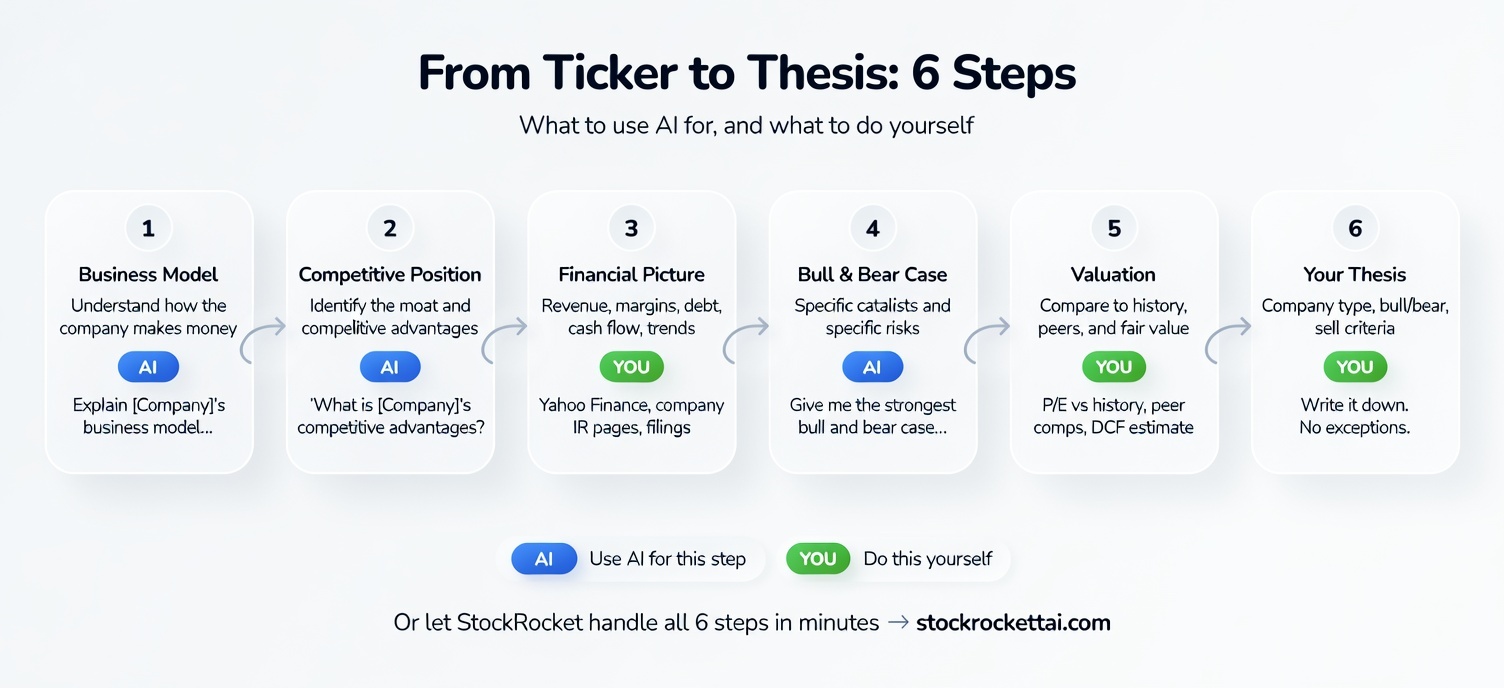
Right, here's where it gets practical. If you're going to use a general-purpose AI for stock research, here's how to actually do it properly rather than just asking "is X a good stock?"
Step 1: Start with the business model, not the numbers
Your first prompt should never be about financials. Start with understanding what the company actually does and how it makes money.
Try something like: "Explain [Company]'s business model as if I were considering buying the entire company. How do they generate revenue? What are the main business segments and how much does each contribute? Who are their customers?"
This forces the AI to go deeper than a Wikipedia summary. You want to understand the business before you look at a single number. As Warren Buffett would say, stay within your circle of competence and if you can't understand how a company makes money after this step, that's a useful signal in itself.
Step 2: Understand the competitive position
Once you understand the business, dig into why customers choose them over alternatives.
Try: "What is [Company]'s competitive advantage? What would a competitor need to do to take their market share? How durable is this advantage over the next 5-10 years?"
This gets at the concept of an economic moat. You're looking for things like switching costs, network effects, brand strength, or cost advantages. If the AI can't articulate a clear competitive advantage, that's worth noting.
Step 3: Get the financial picture
Important: This is where we'd actually recommend stepping away from AI entirely. Financial data needs to be accurate, and AI models are simply not reliable sources for specific numbers.
They frequently hallucinate figures, confuse time periods, or pull from outdated sources. When precision matters, and it always matters with financial data, go straight to the source.
Use these instead:
- Company investor relations pages. Every publicly listed company publishes their annual reports, quarterly earnings, and investor presentations on their website. This is the most reliable source and often contains management commentary that gives you context around the numbers.
- Yahoo Finance. Free, comprehensive, and generally accurate for key metrics like revenue, margins, P/E ratios, and cash flow. The financials tab gives you income statements, balance sheets, and cash flow statements going back several years.
- StockAnalysis.com. Another solid free resource with clean presentation of financial data and useful historical comparisons.
The key metrics you want to pull together: revenue growth over the past 3-5 years, profit margins (gross, operating, net), return on equity, debt-to-equity ratio, and free cash flow. Look for trends and consistency rather than obsessing over any single quarter.
Step 4: Build the bull and bear case
This is where AI can be surprisingly useful if you push it.
Try: "Give me the strongest possible bull case for [Company] over the next 3-5 years. Be specific about growth catalysts, not generic. Then give me the strongest bear case. What would have to go wrong for this to be a terrible investment?"
The key phrase here is "be specific." Without it, you'll get generic responses about "macroeconomic headwinds" and "competitive pressures" that apply to literally every company on earth. Push back if the response is too vague. Ask for specific competitors, specific risks, specific catalysts.
Step 5: Assess valuation
Valuation is where you need to do the work yourself. AI models lack reliable access to current data and, more importantly, valuation requires your own judgement about a company's future. Nobody else can decide what a company is worth to you based on your own research and conviction.
What you should do:
- Compare the company's current valuation to its own history. Is the P/E ratio higher or lower than its 5-year average? If it's significantly higher, what's changed to justify the premium? If it's lower, is that an opportunity or a warning sign?
- Compare to peers. How does the company's P/E, EV/EBITDA, and price-to-sales compare to direct competitors? Remember, a bank trading at 13x earnings and a software company at 35x can both be fairly valued. Compare within the same industry, not across them.
- Think about assets and future cash flows. If you were buying this entire company, what would you pay? What are the tangible and intangible assets? How much cash will this business generate over the next 5-10 years? Even a rough estimate forces you to think critically about what you're actually buying. Apply a margin of safety to your estimate, because you will be wrong about something.
This is the hardest part of stock research, and there are no shortcuts. If you don't feel confident putting a rough fair value on the company, that's a strong signal that you don't understand it well enough yet. Go back to the earlier steps. For more on valuation metrics, see our guide on understanding P/E ratios.
Step 6: Compile your thesis
This is the most important step and it should be entirely yours. Your investment thesis is a written document that captures why you're buying, what would make you sell, and what you expect to happen. If you can't write this clearly, you're not ready to buy.
Your thesis should include:
- Company type. Is this a fast grower, a stalwart, a turnaround, an asset play, or a cyclical? This matters because it changes how you evaluate success. A fast grower that stops growing is a sell. A turnaround that hasn't turned around yet might just need more time. Peter Lynch's framework for categorising companies is invaluable here.
- Your bull case. The specific reasons you believe this investment will work. Not generic ones. What catalysts, competitive advantages, or market misunderstandings are you betting on?
- Your bear case. What would have to go wrong? Be brutally honest with yourself here.
- Your sell criteria. This is what separates disciplined investors from everyone else. Write down the specific conditions that would make you exit the position before you buy. If the thesis breaks, you sell. No exceptions, no renegotiating with yourself when emotions are running high. For more on this, our guide on psychological pitfalls covers why this matters so much.
Write it down. Seriously. A thesis that only exists in your head isn't a thesis. It's a vague feeling, and vague feelings don't hold up when a stock drops 20% in a week.
The real problems with using general AI for stock research

Even if you follow every step above perfectly, there are fundamental limitations that no amount of clever prompting can fix.
1. You're rebuilding the wheel every single time
Want to analyse five stocks? You're having five separate conversations, writing five sets of prompts, and getting five analyses that use slightly different frameworks depending on how the model interprets your request that day. There's no consistency. You can't meaningfully compare the output from one stock to another because the methodology shifts each time.
2. The data problem is real
Financial data needs to be accurate and current. AI models are not financial databases. Even with internet access, they frequently pull numbers from unreliable aggregator sites, confuse TTM (trailing twelve months) with annual figures, or simply make numbers up when they're not sure. For an activity where precision matters, this is a serious issue.
3. There's no technical analysis
General AI models can talk about RSI and moving averages in theory, but they can't actually look at a chart or calculate technical indicators from real price data. If momentum and timing matter to you (and they should), you're on your own.
4. Nothing is saved or tracked
You spend 45 minutes building a great analysis of a stock. Two months later, you want to check whether your thesis still holds. Where is it? Buried in a chat history somewhere, if it hasn't been deleted. There's no portfolio view, no way to track how your thesis has evolved, and no alerts when something material changes.
5. It takes longer than you think
By the time you've written your prompts, fact-checked the financial data, formatted the output into something useful, and repeated this for each stock on your watchlist, you've spent hours doing what should be a structured, repeatable process.
A better approach to AI-powered stock research
This is exactly why we built StockRocket.
We went through this exact journey ourselves. We were the person spending Sunday mornings bouncing between ChatGPT, Yahoo Finance, annual reports, and a Google Doc trying to piece together a proper stock thesis. It worked, sort of, but it was slow, inconsistent, and the output was never quite at the level we wanted.
StockRocket takes everything we've discussed in this guide and packages it into a single, purpose-built platform:
- Structured reports using proven frameworks. Every report follows the same methodology, grounded in the investment principles of Peter Lynch and Warren Buffett. Company analysis, fundamentals, technical analysis, risk assessment, bull and bear cases. All structured consistently so you can compare stocks meaningfully.
- Real financial data, not AI guesses. We pull financial metrics from verified data sources, not from an AI model's best guess at what last quarter's revenue might have been. When you see a P/E ratio in a StockRocket report, you can trust the number.
- Technical analysis included. Support and resistance levels, RSI, moving averages, MACD, Bollinger Bands. All calculated from real price data and presented alongside the fundamental analysis so you get the complete picture.
- Your research, saved and tracked. Every report is saved to your account. Build a watchlist. Add your own notes and commentary. Come back in three months and see whether your original thesis still holds. This is how professional analysts work, and now you can too.
- Minutes, not hours. Enter a ticker, get a comprehensive report. Then use StockRocket's AI chat to ask follow-up questions about anything in the report. The depth of a Sunday morning research session, delivered in the time it takes to make a coffee.
If you've been doing stock research the manual way (and based on the number of "how do I use AI for stocks" posts we see daily, many of you have), give StockRocket a try. Your first reports are free, and we think you'll quickly see the difference between a general-purpose AI conversation and a purpose-built research platform.
Can AI Predict the Stock Market?
Short answer: no. And you should be very sceptical of anyone who claims otherwise.
This is one of the most searched questions about AI and investing, so let's address it directly. AI models — whether they're large language models like ChatGPT and Claude, or machine learning systems trained on price data — cannot reliably predict where a stock or the market will go next.
Why not? Stock prices are driven by a combination of fundamentals, sentiment, macroeconomic events, geopolitics, and millions of individual decisions. Markets are adaptive — the moment a pattern becomes predictable, traders exploit it and the edge disappears. This is the efficient market hypothesis in action, and while markets aren't perfectly efficient, they're efficient enough that no AI model has demonstrated consistent, repeatable stock price prediction.
Quantitative hedge funds like Renaissance Technologies use sophisticated models to find tiny statistical edges, but they're working with proprietary data, massive computing power, and decades of research — not a chatbot. And even they don't "predict" the market. They find probabilities and manage risk.
Red flag: If someone is selling you an "AI stock predictor" or a tool that claims to forecast stock prices, be extremely cautious. At best, it's pattern-matching on historical data that doesn't generalise. At worst, it's a scam. AI is excellent for research and analysis. It is not a crystal ball.
Summary
AI is a genuinely useful tool for stock research, but only if you understand what it's good at and where it falls short. Use it for structuring your thinking, exploring competitive dynamics, and building bull and bear cases. Don't use it as a source of truth for financial data, and don't expect it to give you conviction.
If you want to use general AI models effectively:
- • Start with the business model, not the numbers
- • Push for specifics on competitive advantages and risks
- • Always verify financial data independently
- • Use it as a research assistant, not an oracle
- • Build a consistent framework you apply to every stock
Or skip the manual process entirely and let StockRocket do the heavy lifting for you. Either way, the most important thing is that you're doing the research at all. As we've said before, many people spend less time researching a stock than they do researching a new bike. Don't be that person.
For more on building a solid investment process, check out our other guides:
How to Analyse a Stock
The complete framework
The P/E Ratio Explained
Understanding the most common valuation metric
Avoiding Psychological Pitfalls
Keep your head when others lose theirs
Thinking About Investing for the First Time
Start here if you're brand new
Happy researching!
Frequently asked questions
Ready for AI-Powered Stock Research?
Get comprehensive stock analysis in minutes
No credit card required • Get started in seconds